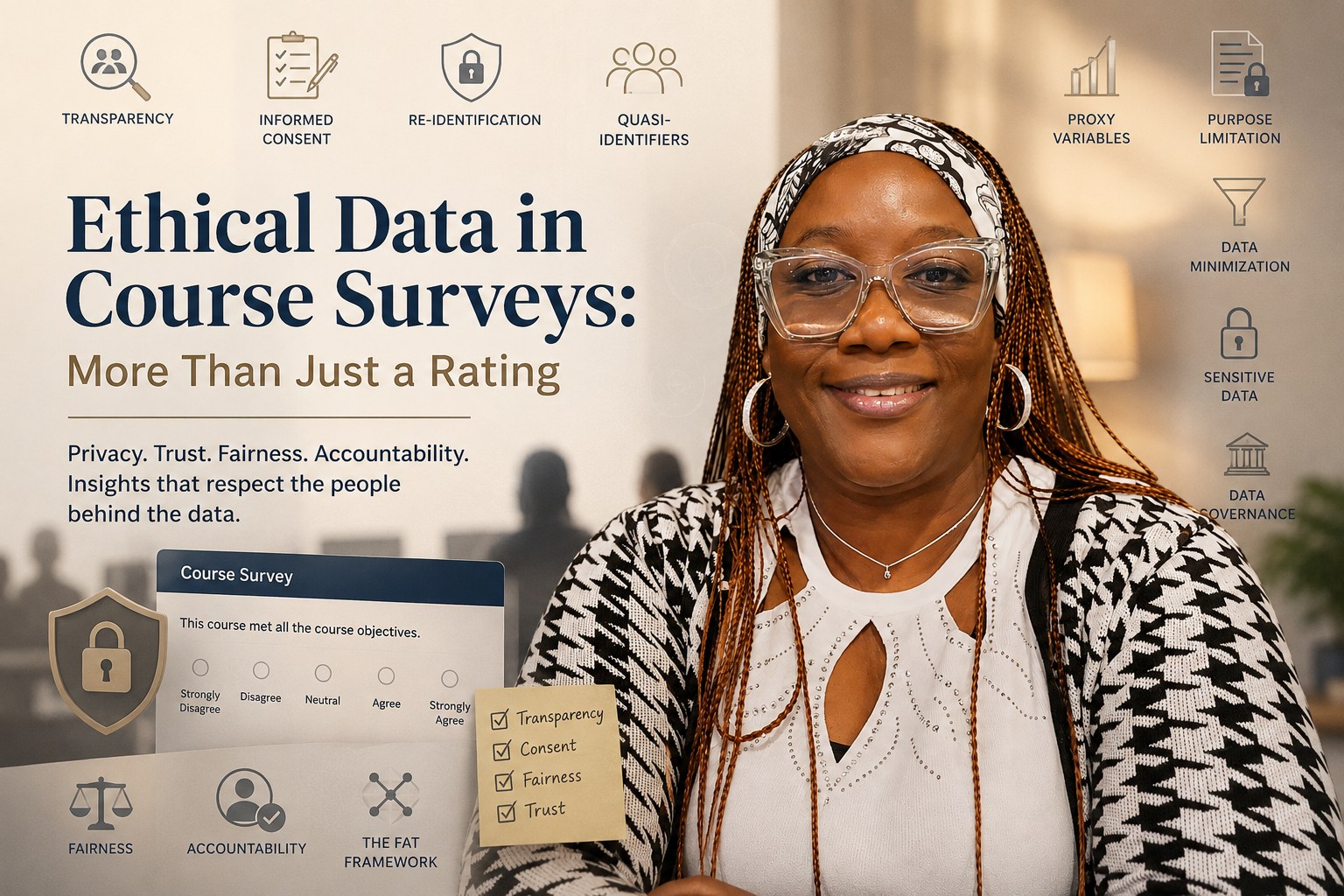
A course survey looks like the most harmless thing in the world. You finish a class, a short feedback form appears, and a friendly note promises your answers are anonymous. In this scenario, though, that simple survey carries real weight, because management plans to use the results to decide which courses get redesigned, and I’m the analyst expected to turn the answers into useful insights. When data drives decisions like that, how it’s collected matters as much as what it says.
Here’s the setup. Students finish a course and open a survey through a temporary link. They log in with their organization username and password, type in the course name but not their own, and rate statements like “This course met all the course objectives” from strongly disagree to strongly agree. The page promises the survey is anonymous. It looks routine. Looked at closely, it isn’t.
The Anonymity That Doesn’t Hold Up
The first problem is the promise of anonymity itself. Students have to log in with their organization credentials, and the moment that happens, the system can tie a response back to a person, even if no name shows up in the final report. Logins, timestamps, IP addresses, and account IDs can all sit quietly in the background. So the survey is really confidential or pseudonymous, not anonymous, and saying otherwise gives students a false sense of privacy. That’s a transparency problem.
The course name makes it worse. In a small class, or when only one person responds during a short window, answers can be traced back to individuals. The course name works as a quasi-identifier: it names no one on its own, but combined with login times, schedules, or an instructor’s knowledge of the class, it can. Even details like section, campus, or delivery mode act as proxy variables that re-identify people in small groups.
There’s also a consent gap. Students hear “anonymous,” but they’re not told what’s actually collected, who sees it, how long it’s kept, or that their feedback could shape course and instructor decisions. Real informed consent means spelling those things out.
The Question That Tries to Do Too Much
The sample question has its own problems. “This course met all the course objectives” asks students to judge everything at once — curriculum, teaching, assessments, pacing, and resources — in a single rating. Most students don’t even know the full list of official objectives, and a course can easily meet some but not others. That broad wording produces fuzzy data that’s hard to act on.
And since students just logged in with their real credentials, some may shade their answers more positively, worried that honest criticism could somehow follow them. That’s a quiet source of bias.
What Else Could Be Going Wrong
Even beyond what’s visible, a few more risks are worth naming:
- Data governance. Who owns the results, who can see the raw data, and who’s responsible for protecting it? Without clear rules, the data can drift into other uses.
- Purpose limitation. The stated purpose is improving courses. If the same data later evaluates instructors or tracks individuals, that goes past what people agreed to.
- Data minimization. If the goal is course-level feedback, collecting usernames, IDs, device info, and login logs is more than the job needs.
- Sensitive data. If there’s a comment box, students may share struggles with health, money, or an instructor, and the organization has to be ready to handle that responsibly.
- Fairness and access. A short response window shuts out students who are working, caregiving, unwell, or facing tech or accessibility barriers, which skews results toward whoever happened to be free.
- Misleading reporting. An average of 4 out of 5 can hide a handful of serious complaints, and a low score from three responses isn’t strong evidence. Numbers need context: sample size, response rate, and limitations.
What I’d Recommend
If I were advising executive management, I’d keep it practical:
- Tell the truth about anonymity. If students must log in, don’t promise full anonymity. Say plainly whether responses are anonymous, confidential, or de-identified.
- Separate identity from answers. Let the system confirm a student is eligible, then issue a random token that isn’t stored with their responses. That blocks duplicate submissions without linking answers to a name. If that’s not possible, lock raw data down to a few authorized people.
- Use the FAT framework — fairness, accountability, transparency. Keep the survey accessible and open long enough for everyone, put someone clearly in charge of privacy and data use, and make sure students understand how their feedback will be used.
- Fix the questions. Replace the one broad statement with specific ones like “The assessments matched what the course taught” or “The materials supported my learning.” Sharper questions give clearer, more useful answers.
- Protect small groups. Don’t report results for a course or section unless enough students responded, combine small groups where it makes sense, and redact comments that could identify someone.
- Set retention limits and use more than one source. Decide how long raw data lives before deletion, and treat the survey as one input among several, alongside assessment results and curriculum reviews, rather than the whole basis for a decision.
If Management Won’t Listen
Suppose leadership waves all this away and insists the survey is fine. I’d still have a responsibility to act ethically, and accountability stays with me.
First, I’d document my concerns clearly and professionally — the misleading anonymity claim, the re-identification risk, the weak consent, the bias — so there’s a record that I raised them. Then I’d escalate through the right channels: a manager, privacy officer, data governance team, or legal, calmly and backed by evidence.
I’d also limit my own work to the most ethical version possible, reporting only aggregated results, suppressing small groups, masking identifiers, and stating the limitations instead of dressing the data up as more solid than it is. And I’d watch my wording, avoiding claims like “students think this course failed” when the data can’t carry that weight. That is ethical reporting in practice.
If management still wanted to use the data in a way that could mislead or harm students, I’d have to ask whether I could keep working on it. An analyst shouldn’t help produce a report that hides problems they know about. As a last resort, that can mean asking to step off the project or using formal whistleblowing channels. It’s not where anyone wants to end up, but ethics sometimes asks for the harder choice.
Final Thought
The real lesson here is how ordinary the danger looks. A login, a temporary link, a course-name box, and one friendly word — “anonymous” — seem harmless on their own. Together they create real risks to privacy, consent, fairness, and trust, and a single vague question can quietly weaken the whole dataset.
My job as an analyst isn’t only to build charts and recommendations; it’s to protect the integrity of the analysis and the people behind the numbers. Students give honest feedback when they trust that their privacy is respected and their words are used fairly. Get that part right, and the insights take care of themselves.