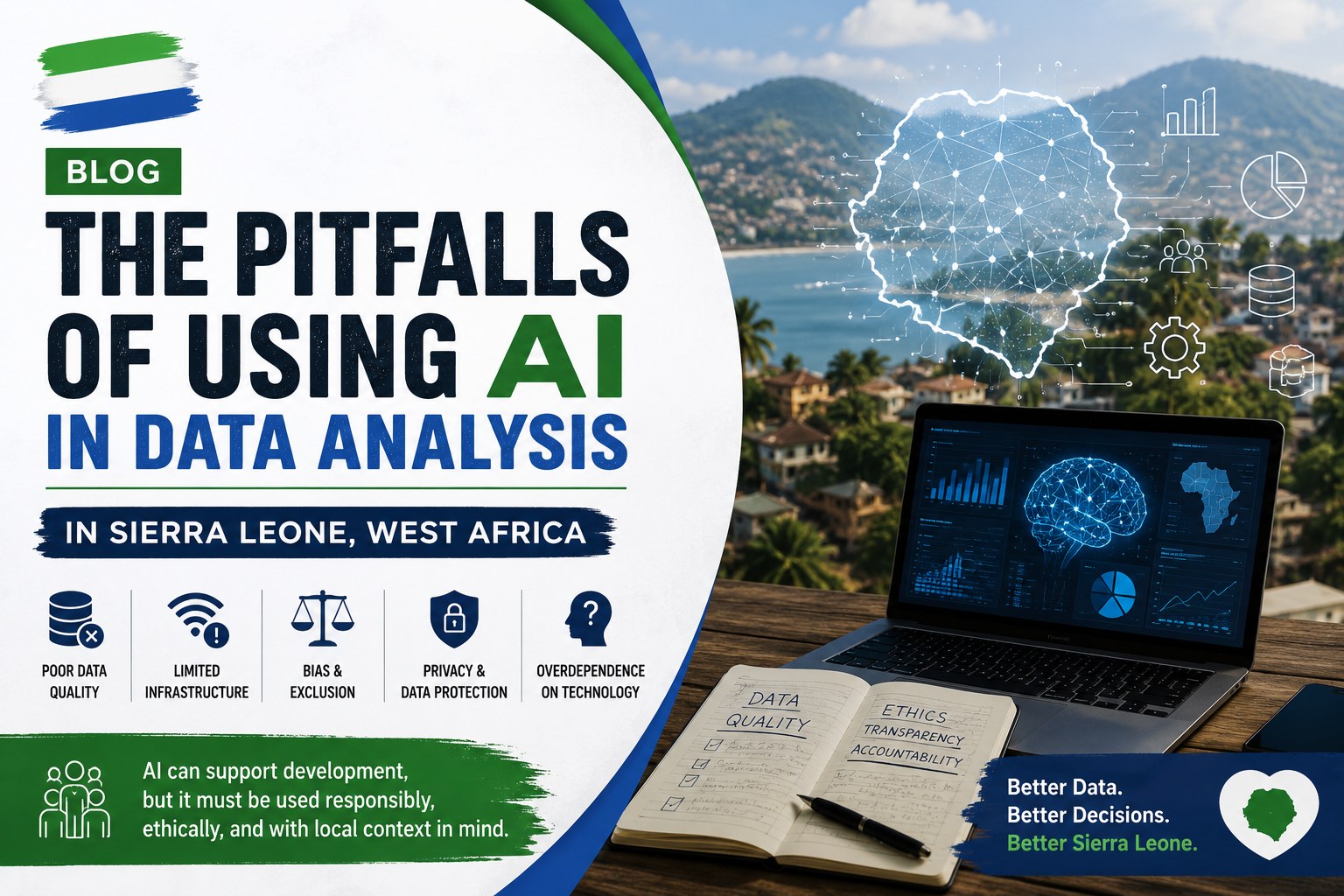
Artificial intelligence is becoming one of the most powerful tools in modern data analysis. Around the world, governments, businesses, schools, hospitals, and nonprofit organizations are using AI to study patterns, predict future needs, and make decisions faster. In Sierra Leone, West Africa, AI has the potential to support development in important areas such as healthcare, agriculture, education, climate response, public service delivery, and economic planning. However, while AI can be useful, it also comes with serious pitfalls that must be carefully considered.
Sierra Leone is already moving toward a stronger digital future. The government’s digital transformation work includes expanding broadband internet, improving digital skills, and strengthening the ability of public institutions to deliver services digitally. The Sierra Leone Digital Transformation Project is described as a five-year project supported by a US$50 million grant, with goals that include expanding broadband access, enhancing digital skills, and improving government digital service delivery. This shows that the country is not standing still. There is a clear interest in using technology for national development. Sierra Leone has also begun work toward responsible AI, with the Ministry of Communication, Technology and Innovation stating that the country is developing its first National AI Strategy with support from the World Bank Group.
Poor Data Quality
Even with this progress, using AI in data analysis without caution can create more problems than solutions. One of the biggest pitfalls is poor data quality. AI depends on data. If the data is incomplete, outdated, biased, or poorly collected, the results will also be unreliable. In Sierra Leone, many institutions may still depend on paper records, manual data entry, or fragmented databases. For example, health data may be stronger in large hospitals in Freetown than in rural clinics. Education data may capture formal school enrollment but miss children who are out of school, moving between communities, or affected by poverty. Agricultural data may not fully represent smallholder farmers in remote districts. If AI systems are trained mainly on the data that is easiest to collect, they may ignore the people who are hardest to reach.
This matters because AI can make weak data look more scientific than it really is. A dashboard, model, or prediction may appear professional and accurate, even when the underlying data is incomplete. For example, if an AI system is used to predict which communities need the most healthcare support, but the data comes mainly from areas with better reporting systems, the model may direct resources toward communities that are already more visible. Communities with poor internet, weak recordkeeping, or limited access to government services could be left behind. In this way, AI can unintentionally strengthen existing inequalities.
Limited Infrastructure
Another major pitfall is limited infrastructure. AI systems often require stable electricity, reliable internet, cloud storage, secure networks, and updated devices. Sierra Leone has made digital progress, but infrastructure challenges remain. The country’s own Digital Development Policy notes that despite progress, Sierra Leone still faces issues such as uncoordinated digital infrastructure programs, inadequate legal and regulatory frameworks, and outdated digital development strategies. These challenges directly affect AI adoption. If data analysts, schools, clinics, and local government offices cannot reliably access digital tools, then AI will mostly benefit institutions and communities that already have better resources.
This creates a serious urban-rural divide. AI tools may work better in Freetown or other connected areas, while rural communities may remain excluded. This is dangerous because many of Sierra Leone’s development challenges are not only urban. Rural areas are deeply connected to agriculture, food security, maternal health, education access, roads, markets, and climate vulnerability. If AI-driven data analysis does not include rural realities, then national planning may become unbalanced. The technology may produce fast answers, but not necessarily fair or accurate answers.
Bias and Exclusion
Bias is another serious concern. AI systems often reflect the assumptions built into their training data, design, and use. If AI tools are imported from outside Sierra Leone, they may not understand local languages, cultural practices, informal work, family structures, or community decision-making. Sierra Leone has many languages and local contexts. A model trained mainly on English-language data or Western examples may misread local needs. For example, informal businesses may not leave the same digital records as formal businesses, even though they are essential to the economy. Women’s unpaid labor, caregiving, market trading, and community work may also be undercounted. If this kind of data is missing, AI may undervalue the contributions of women and informal workers.
There is also a risk that AI can make discrimination harder to see. Traditional bias can sometimes be questioned directly. AI bias is often hidden inside algorithms, model weights, or technical processes that many users do not understand. A government office or organization may trust an AI recommendation without knowing why the system produced that result. This lack of transparency is a major problem. People affected by AI-based decisions should be able to understand how those decisions were made, especially when the decisions involve public benefits, healthcare access, education, employment, loans, or social services.
Privacy and Data Protection
Privacy is another major pitfall. AI systems usually need large amounts of data, and some of that data can be personal or sensitive. In Sierra Leone, this could include health records, school records, voter information, mobile money data, biometric data, location data, or household survey information. If this data is not properly protected, people can be harmed. Data leaks can expose private information. Poor consent practices can allow organizations to collect data from people who do not fully understand how it will be used. Communities may be studied repeatedly without receiving direct benefits from the data collected about them.
Sierra Leone has recognized the importance of this issue. In 2026, the government announced Cabinet approval of its first National Data Protection Policy, which is intended to guide the collection, processing, storage, and sharing of personal data. The policy is also expected to support modern digital governance and strengthen public trust. This is an important step, but policies must be enforced in practice. A data protection policy alone is not enough if institutions lack trained staff, secure systems, clear accountability, and public awareness.
Overdependence on Technology
Another problem is overdependence on AI. AI can support human decision-making, but it should not replace human judgment, especially in a country with complex social and economic realities. Data analysis is not only about numbers. It also requires local knowledge, ethical reasoning, and understanding of context. For example, an AI system may identify a district as “low risk” based on past data, but local leaders may know that flooding, migration, disease outbreak, or food shortages are increasing. If decision-makers trust AI more than community knowledge, they may miss urgent problems.
The Skills Gap
The skills gap is also a major challenge. For AI to be useful in Sierra Leone, the country needs more trained data analysts, AI specialists, cybersecurity professionals, statisticians, policymakers, and ethics experts. It is not enough to buy AI tools or accept donated technology. Local people must understand how the systems work, how to question the results, and how to fix problems when they appear. Without local expertise, Sierra Leone may become dependent on foreign companies, foreign consultants, or foreign-built systems. This can create another kind of dependency, where the country owns the data but does not fully control the technology used to analyze it.
Technology-First Thinking
There is also the risk of “technology-first” thinking. Sometimes governments and organizations adopt AI because it sounds modern, not because it is the best solution. In some cases, basic improvements may be more important than AI. For example, a clinic may need reliable patient records before it needs predictive analytics. A school system may need accurate enrollment data before it needs AI-driven education planning. A farming project may need better field data before it needs machine learning. If organizations rush into AI before fixing basic data systems, the results may be expensive, confusing, and ineffective.
Inequality Between Institutions
AI can also deepen inequality between institutions. Large organizations with funding, technical staff, and international partnerships may benefit from AI, while smaller local organizations may fall behind. This can affect NGOs, schools, community groups, and small businesses. If only well-funded institutions can access advanced data tools, then they may gain more influence over development decisions. Smaller community-based organizations may have valuable local knowledge but lack the technical resources to compete. This imbalance can affect whose voices are heard.
Who Is Accountable?
Another pitfall is accountability. When AI produces a wrong recommendation, who is responsible? Is it the software developer, the government agency, the data analyst, the donor, or the institution using the tool? This question matters because AI decisions can affect real people. If an AI system incorrectly identifies a group as low priority for aid, people may suffer. If it wrongly flags someone as ineligible for a service, that person may be denied support. Sierra Leone must make sure that human beings remain accountable for decisions made with AI assistance.
Conclusion
In conclusion, AI has real potential to support data analysis and development in Sierra Leone, but it must be used carefully. The country should not reject AI, but it should not accept it blindly either. The main risks include poor data quality, weak infrastructure, bias, privacy concerns, lack of transparency, overdependence on technology, limited local expertise, and weak accountability. To avoid these pitfalls, Sierra Leone needs strong data governance, better infrastructure, investment in local digital skills, public education, ethical review processes, and meaningful community involvement. Most importantly, AI should support local knowledge rather than replace it. Used responsibly, AI can help Sierra Leone make better decisions. Used carelessly, it can repeat old inequalities in a new digital form.