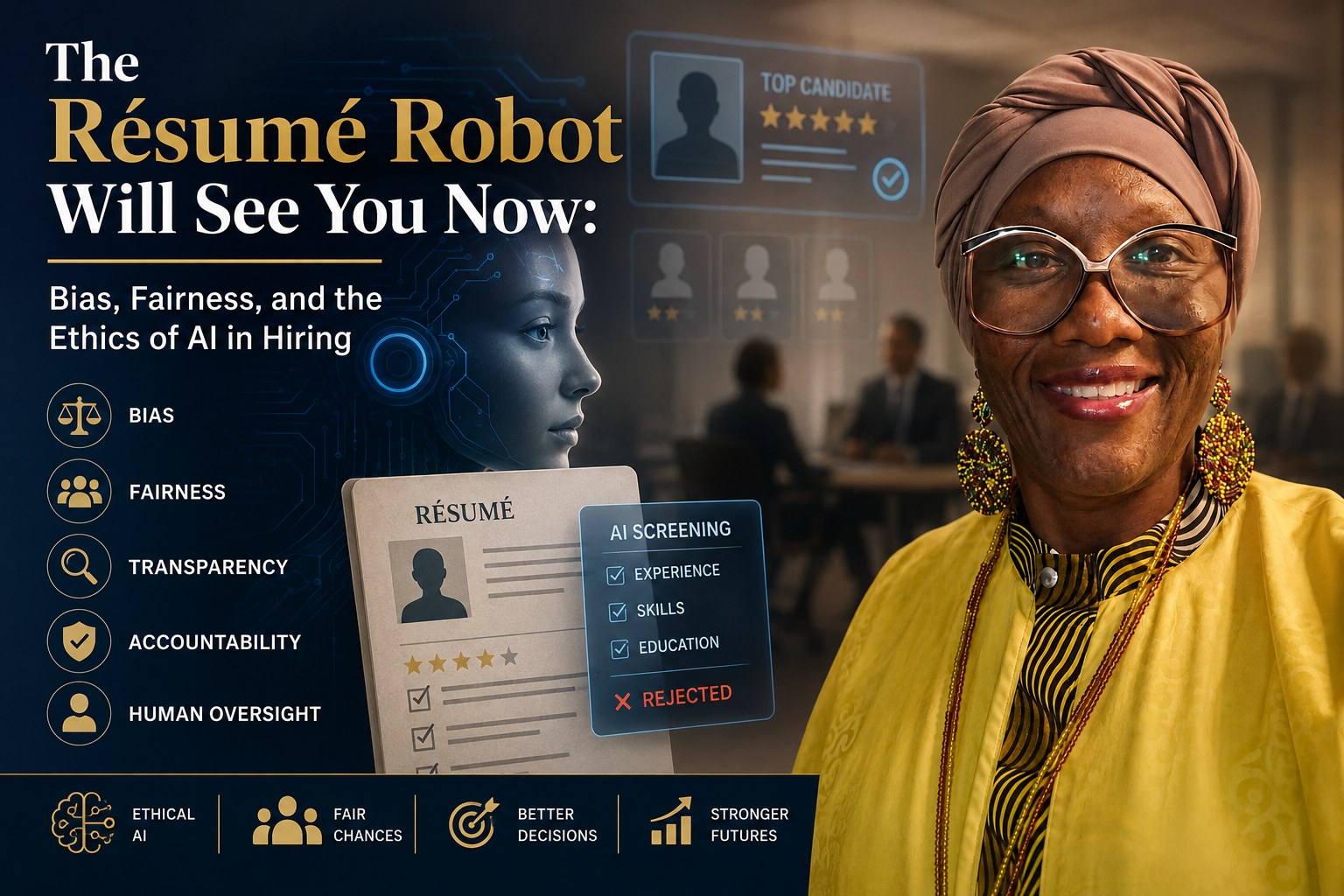
Imagine spending hours fixing your résumé, matching it to a job posting, and finally clicking “Submit,” only to be rejected by a machine before a real person even sees your name. For many job seekers, this is already happening. AI is now used in many hiring processes to screen applications, rank candidates, and sometimes even review video interviews before a recruiter gets involved.
Because I have worked in HRIS and Workday environments, I understand why companies use automated systems. They can save time, organize large amounts of information, and make hiring processes more efficient. But there are also serious ethical concerns. The main question is: what happens when the system that decides who gets a chance has learned unfair patterns from the past?
In this post, I will look at how bias can show up in AI hiring tools, using ethical AI principles, soft ethics, and a real-world example from Amazon.
How Hiring Algorithms Work
AI hiring tools work by looking for patterns. A company gives data from past hiring decisions, such as résumés, job history, promotions, and information about who was hired. The system then learns what past “successful” candidates looked like and uses that pattern to score new applicants.
The problem is that the AI is not always learning what makes someone a good employee. It may simply be learning what the company’s past hiring choices looked like. If those past choices were biased, the AI can repeat the same bias. It may even make the bias worse because it can apply quickly across many applicants.
Where Bias Comes From
Bias in AI hiring systems does not always come from someone intentionally creating unfair code. It can come from the data and the choices made during the design of the system.
- Historical training data. If a company hired mostly men into technical roles for many years, the AI may learn that male candidates are a better fit, even if that is not true.
- Proxy variables. Even if the system does not use gender, race, or age directly, it may still guess those things through other details, such as postal codes, school names, employment gaps, or certain words on a résumé.
- Feedback loops. If a biased system keeps selecting the same kinds of candidates, those new hires become part of the future data. This can make the bias continue and become stronger.
- Unrepresentative data. If some groups were not well represented in the past, the AI may not know how to evaluate them fairly.
This is why data science ethics is important. The fairness of the output depends heavily on the data that goes into the system and how the company defines “success.”
Amazon’s Recruiting Tool
A well-known example of AI hiring bias is Amazon’s recruiting tool. Between 2014 and 2017, Amazon developed an experimental system to score job applicants. The system was trained using about ten years of résumés submitted to the company. Since the technology industry had been male dominated, the data mostly reflected male applicants and male hires.
As a result, the system learned to favor male candidates. It reportedly penalized résumés that included the word “women’s,” such as “women’s chess club captain.” It also downgraded graduates from two all-women’s colleges. Amazon tried to fix some of these issues, but the company could not guarantee that the system would not find other ways to discriminate. In the end, Amazon stopped using the tool.
This example shows that bias is not always caused by bad intentions. Sometimes it is built into data. It also shows that fairness cannot just be added at the end. Ethics must be part of the design from the beginning.
Applying Floridi’s Five Principles
Luciano Floridi’s five principles are helpful for looking at AI hiring systems. These principles are beneficence, non-maleficence, autonomy, justice, and explicability.
- Beneficence means AI should support people’s well-being. In hiring, AI should help connect qualified people with opportunities, not block them unfairly.
- Non-maleficence means AI should avoid harm. If a system screens out qualified candidates because of gender, race, postal code, or other unfair factors, it is causing real harm to people’s careers and income.
- Autonomy means humans should still have meaningful decision-making power. Recruiters should not just accept AI’s ranking without question. A human should be able to review and challenge the system’s recommendation.
- Justice means the benefits and burdens of AI should be fair. If an AI hiring tool keeps favoring groups that were already advantaged in the past, it is not promoting justice.
- Explicability is especially important for AI. It means the system should be explainable and accountable. If someone is rejected because of an AI tool, they should be able to understand why. A company should not be able to hide behind “the computer said no.”
Hard Law and Soft Ethics
Laws and regulations are important, but they are not always enough. The European Union’s AI Act classifies AI systems used in employment and recruitment as high-risk. This means companies have to follow rules around risk management, data quality, documentation, transparency, and human oversight.
This is a good step, but law usually moves slower than technology. Also, following the law is only the minimum standard. A company can technically follow the rules and still make choices that are unfair or harmful.
This is where soft ethics matters. Soft ethics asks companies to go beyond simply asking, “What are we legally allowed to do?” Instead, it asks, “What is the right thing to do?” For example, a company using soft ethics would not only meet legal requirements. It would also audit its hiring system, explain decisions to candidates, check for unfair outcomes, and accept responsibility when something goes wrong.
Ethical Distractions
One concern is that companies can talk about ethics without really practicing it. Floridi describes several unethical distractions that can apply to AI hiring.
- Ethics shopping happens when a company chooses whichever ethical framework supports what it already wants to do.
- Ethics blue washing happens when a company publicly claims to be ethical, but the actual system is not properly tested or audited.
- Ethics lobbying happens when companies use the language of ethics to avoid stronger legal rules.
- Ethics dumping happens when companies test or use questionable systems in places with weaker protection.
- Ethics shirking happens when companies avoid doing real ethical work because they think no one will hold them accountable.
This means we should be careful when a vendor says its AI tool is “fair” or “ethical.” We should ask how it was tested, who audited it, what standard was used, and what happens if the system fails.
What Fairer AI Hiring Could Look Like
I do not think AI needs to be completely removed from recruitment. If used carefully, it can help reduce some human bias, find overlooked candidates, and help recruiters manage large numbers of applications.
However, companies need to use these tools responsibly. They should complete an ethical impact assessment before using the system. They should audit the training data and test the results for unfair impact on different groups. They should also keep humans involved in the decision-making process. Candidates should be given clear information about how automated screening works. There should also be someone responsible for the system’s outcomes. “The algorithm did it” should never be accepted as an excuse.
Conclusion
Hiring decisions can affect a person’s entire future. Losing out on a job opportunity can impact income, career growth, confidence, and long-term stability. That is why AI hiring tools need strong ethical oversight.
The Amazon example shows that algorithmic bias is not just a technical problem. It is also a social and ethical problem because the system can reflect unfair patterns from the past. Floridi’s five principles help us evaluate these systems, while laws like the EU AI Act provide a basic legal standard. Soft ethics pushes companies to go further and do what is right, not just what is required.
For me, the main point is simple: AI can support hiring decisions, but it should not replace human judgment. A résumé robot should never be the only thing standing between a qualified person and a real opportunity.